Drivers pay £11.94 more at motorway services, and 6 other things Britain's motoring data reveals
Motorway fuel costs £11.94 more a tank, Chinese brands take 11.6% of new cars and 1,719 Ford Sierras remain. Seven findings from the UK's official motoring data.

News
£11.94
extra to fill up at motorway services, one of 7 findings
- £11.94 extra to fill a 55-litre petrol tank at motorway services
- 11.6% of first registrations went to Chinese brands
- 50.04% driving test pass rate, the highest in records back to 2007/08
- 121,171 public EV chargers in the UK, up 10% in a year
Official data on Britain’s cars, roads and fuel is published by several government bodies, in thousands of spreadsheets and tables. UK Motoring brings it together in one free place, and these are seven of the most striking things it shows.
Each finding links to a full story with the figures behind it. Fuel prices are from 06:47 on 17 September 2026; the other figures cover the latest period each dataset publishes.
How much more do drivers pay at motorway services?
Filling a 55-litre tank with petrol at motorway services cost £11.94 more than at a supermarket. Motorway forecourts averaged 190.6p a litre, against 168.8p at supermarkets.
The cost of convenience
Diesel drivers paid 19.5p a litre more on the motorway, £10.75 on a 55-litre fill. The dearest motorway petrol was 199.9p a litre, at four Esso-branded Asda Express motorway forecourts.
The prices come from the government’s Fuel Finder scheme, which requires forecourts selling to the public to report price changes within 30 minutes. Our full analysis is in how much more motorway services charge for fuel.
How to pay less
Filling up before joining the motorway is the simplest saving. Our fuel finder shows the cheapest forecourts near any postcode, updated twice a day.
| Finding | Figure | Data and period |
|---|---|---|
| Extra to fill up at motorway services | £11.94 | Fuel Finder, 17 September 2026 |
| Gap between cheapest and dearest areas | 14.2p a litre | Fuel Finder, 17 September 2026 |
| Chinese brands’ share of first registrations | 11.6% | DfT, 12 months to March 2026 |
| Driving test pass rate | 50.04% | DVSA, April 2025 to March 2026 |
| Ford Sierras still licensed | 1,719 | DfT, end of March 2026 |
| Motorcyclists’ share of road deaths | 1 in 4 | DfT, 2025 |
| Public EV chargers | 121,171 | DfT, 1 July 2026 |
Where is fuel cheapest and dearest?
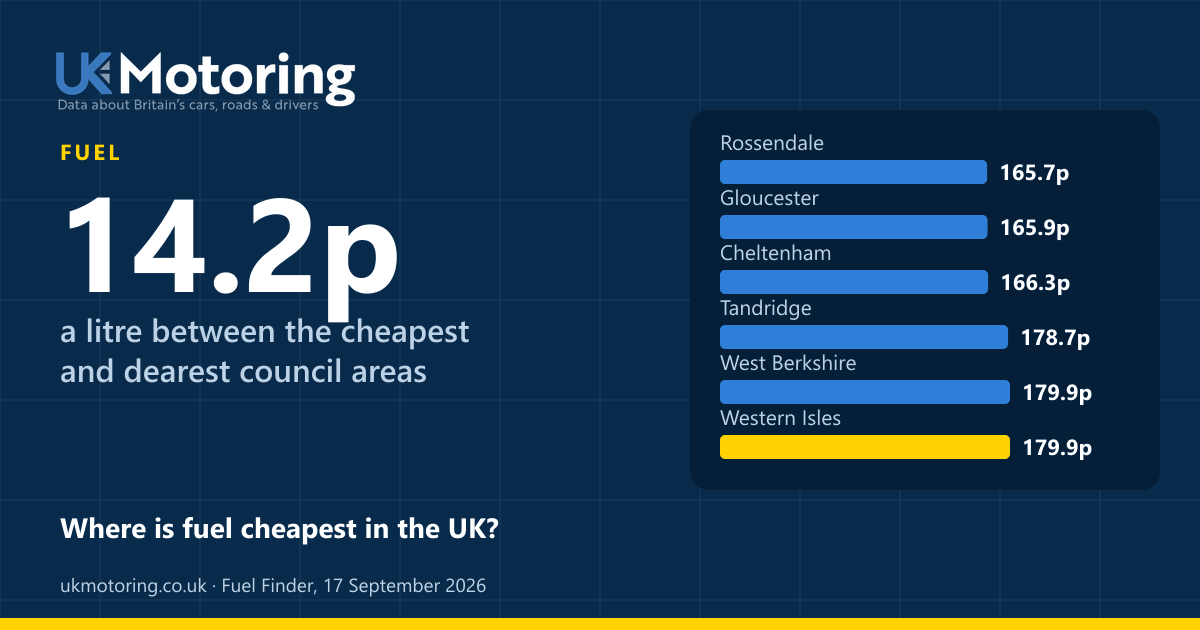
Northern Ireland had the UK’s cheapest petrol, at 166.2p a litre. Among council areas, petrol was 14.2p a litre cheaper in Rossendale than in the Western Isles and West Berkshire.
The cheapest and dearest areas
Rossendale in Lancashire averaged 165.7p a litre, the lowest of any council area with at least five forecourts. The Western Isles and West Berkshire were dearest at 179.9p, a gap of £7.81 on a 55-litre fill.
See every area in where fuel is cheapest in the UK.
Premium petrol adds up
Super unleaded cost 17.2p a litre more than standard E10, adding £9.46 to a 55-litre tank. The full comparison, including which brands charge the biggest premium, is in is super unleaded worth the extra.
How fast are Chinese car brands growing in Britain?
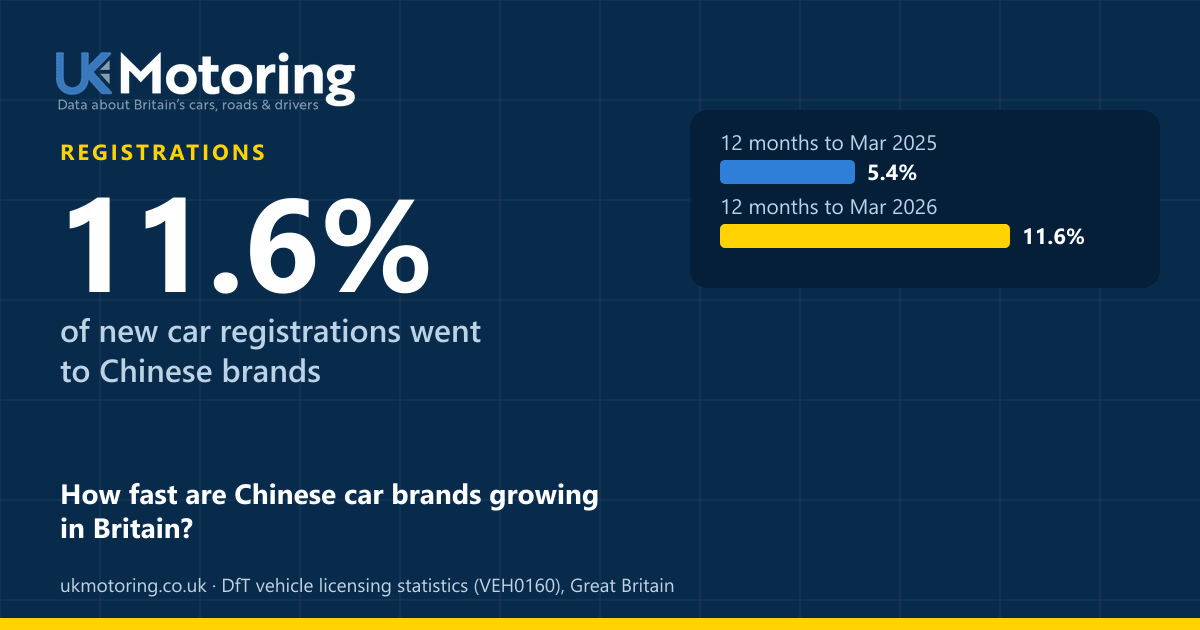
Brands including MG, BYD, Jaecoo and Omoda took 11.6% of cars registered for the first time in Great Britain in the 12 months to March 2026. That’s up from 5.4% a year earlier.
BYD passes Tesla and Land Rover
BYD registered 62,425 cars over the year, more than Land Rover (61,024) and Tesla (44,307). In January to March 2026, Chinese brands’ share reached 13.8%.
The Jaecoo 7 was the second most registered car in that quarter, 126 registrations behind the Ford Puma. The figures are from the Department for Transport’s vehicle licensing statistics.
What the figures count
First registrations include used imports registered in Great Britain for the first time, so they aren’t the same as new car sales. The brand-by-brand figures are in how fast Chinese car brands are growing.
Is it getting easier to pass the driving test?
The pass rate hit a record in 2025/26: 50.04% of car driving tests in Great Britain were passed, the highest in records back to 2007/08.
Where you take it makes a difference
Pass rates ranged from 69.66% at Melton Mowbray to 34.26% at Wolverhampton, among centres with at least 1,000 tests. That’s a gap of 35.4 percentage points.
The data can’t show why rates differ. Pass rates reflect who tests at each centre and its local roads, as well as the test itself.
Every centre is compared in the easiest and hardest places to pass.
How many old favourites are still on the road?
Just 1,719 Ford Sierras were licensed in Great Britain at the end of March 2026, against 1,060,846 at the end of 1994. Another 10,521 were declared off the road.
A classic comeback
The Ford Sierra’s numbers are now rising again, up 6.7% in a year. Other once-familiar cars are rarer still, with only 245 Austin Metros licensed.
Read more in the cars disappearing from Britain’s roads.
Who is most at risk on Britain’s roads?
Motorcyclists accounted for one in four road deaths in Great Britain in 2025: 386 of the 1,538 people killed.
Deaths fell, serious injuries rose
Road deaths fell 4.0% on 2024, but the number of people killed or seriously injured rose 3.6% to 29,918. Deaths among motorcyclists rose 13.5%.
The figures are from DfT’s reported road casualties for 2025. The full picture by road user is in who is most at risk on Britain’s roads.
How many public EV chargers does the UK have?
The UK had 121,171 public EV chargers on 1 July 2026, up 10% in a year.
A big gap between areas
London had 345.1 public chargers per 100,000 people, against 60.0 in Northern Ireland. Our charger finder shows public charging locations near any postcode or town.
The council-by-council comparison is in where the UK’s public EV chargers are.
Where does UK Motoring’s data come from?
Every figure comes from official or open data, including the government’s Fuel Finder scheme, the Department for Transport and DVSA. Each one names its source and the period it covers.
How we check the figures
Our methodology sets out how each statistic is calculated, and data sources lists every dataset with its licence. If you think a figure is wrong, tell us and we’ll check it against the source.
Free tools and emails
The same data powers free tools, including a weekly email of the cheapest fuel near you and My Garage reminders. Journalists and researchers are welcome to use the figures with a credit and a link.
FAQs
How much more does fuel cost at motorway services?
At 06:47 on 17 September 2026, petrol averaged 190.6p a litre at motorway services against 168.8p at supermarkets. That's £11.94 more to fill a 55-litre tank.
Where is petrol cheapest in the UK?
Northern Ireland had the cheapest petrol of the four nations at 166.2p a litre. Among council areas with at least five forecourts, Rossendale was cheapest at 165.7p.
How many new cars are Chinese brands?
Brands including MG, BYD, Jaecoo and Omoda took 11.6% of cars registered for the first time in Great Britain in the 12 months to March 2026, up from 5.4% a year earlier.
What is the driving test pass rate?
50.04% of car driving tests in Great Britain were passed between April 2025 and March 2026, the highest in records back to 2007/08.
How many Ford Sierras are left?
1,719 Ford Sierras were licensed in Great Britain at the end of March 2026, against 1,060,846 at the end of 1994. Another 10,521 were declared off the road.
How many public EV chargers does the UK have?
The UK had 121,171 public EV chargers on 1 July 2026, up 10% in a year, according to the Department for Transport.
Where does UK Motoring's data come from?
From official and open datasets, including the government's Fuel Finder scheme, the DVLA and DfT, DVSA and National Highways. Every figure on the site names its source and the date it covers.
Can I use these figures?
Yes. You're welcome to quote them with a credit to UK Motoring and a link to the page the figure is on.
About the author
Chris Richards is the founder of UK Motoring and the man behind SimplyQuote. A petrolhead and supercar lover, he writes about fuel prices, car costs and the data behind Britain’s roads.