Act Before You REact: why TyreSafe wants road users to think differently about tyre safety
TyreSafe’s Tyre Safety Month 2026 campaign asks drivers to check tyres before something goes wrong. We add what 29 million MOTs show about Britain’s tyres.

Road safety
83.4%
of drivers say they fully control their stopping distance
- 83.4% of drivers say they fully control their stopping distance
- 10.7% checked their tyres after their most recent near miss
- 1.86m car MOT failures in 2025 involved a tyre defect
- 201 killed or seriously injured in tyre-related incidents in 2025
Every road user knows that unexpected moments are part of being on the road.
A vehicle suddenly pulls out. Traffic stops sharply. Heavy rain arrives. A pothole appears around a bend. Another road user makes a mistake.
We cannot control everything that happens when we drive. But we can control how prepared our vehicle is for the unexpected.
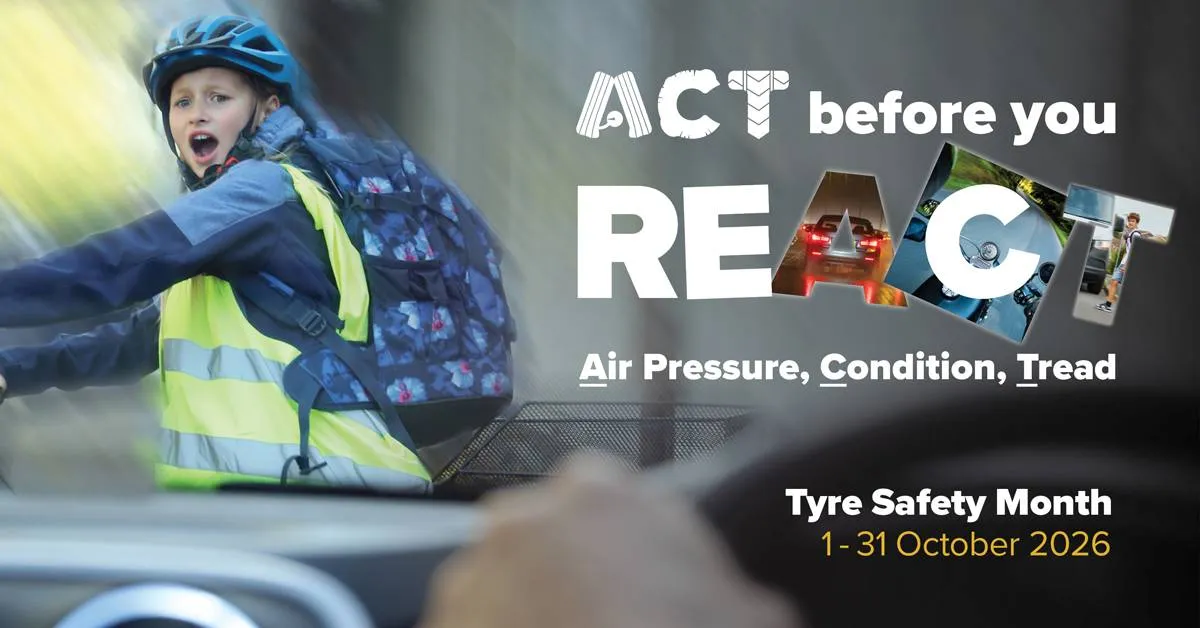
That is the thinking behind TyreSafe’s Tyre Safety Month 2026 campaign, which runs throughout October with a simple message: Act Before You REact.
Tyre Safety Month takes place every October, traditionally one of the wetter months of the year, when drivers are more likely to encounter wet roads and changing autumn conditions. It is therefore a timely reminder that tyres need to be ready to perform when stopping distances increase and grip can become more difficult to maintain.
Tyres are the only part of a vehicle in contact with the road, yet they can be surprisingly easy to overlook. Often, tyre safety only comes to mind when something goes wrong: a puncture, a loss of grip, heavy braking or a near miss.
TyreSafe wants to change that behaviour.
Who is TyreSafe?

TyreSafe is the UK charity dedicated to raising awareness of correct tyre maintenance and the dangers posed by defective and illegal tyres.
Its vision is zero harm to road users on UK roads due to illegal and poorly maintained tyres. Its mission is to empower road users with the knowledge they need to keep their tyres safe and roadworthy, while encouraging positive changes in behaviour.
The organisation works across road safety, education, research, enforcement, industry engagement and public awareness, with more than 260 organisations supporting its vision.
Tyre Safety Month is TyreSafe’s annual opportunity to put tyre safety firmly in the spotlight and encourage road users to make simple preventative checks part of their normal driving routine.
The need for that work remains clear.
On average over the last five years, 163 people have been killed or seriously injured each year in incidents related to defective tyres. In 2025, the figure rose to 201 tyre-related KSIs (killed or seriously injured), 19% higher than the previous year and 38 above the five-year average.
For TyreSafe, those figures reinforce an important point: tyre safety should not be something drivers think about only after an incident. It should be part of preparing for every journey.
Confidence does not equal preparedness
This year’s Act Before You REact campaign is based on new research exploring how confident drivers feel compared with how prepared they actually are for an emergency.
The findings reveal a striking gap.
Some 83% of drivers believe they are in full control of their stopping distance. Yet only 6% correctly identify the stopping distance required in wet conditions at motorway speed, while 94% underestimate stopping-distance risk.
The research also found that 42% of drivers believe they are better than average at handling emergencies.
- Agree they fully control their vehicle’s stopping distance83.4%
- Chose less than 96m of extra stopping distance in the wet at 70mph78.2%
- Chose 24m or less of extra stopping distance in the wet at 70mph37.2%
- Rate their own ability to handle an emergency as above average42.3%
TyreSafe / Opinium, fieldwork 24 to 28 April 2026. Regular car drivers, unweighted n=1,263; percentages are weighted. The 96m benchmark comes from the Highway Code’s typical dry stopping distance at 70mph and its guidance that wet stopping distances are at least double dry ones. These are answers to a survey question, not measured braking performance.
That confidence is not necessarily a bad thing. Feeling capable behind the wheel can be important.
But confidence can become a problem if it creates a false sense that a driver can always overcome whatever happens on the road.
A driver can react quickly. They can brake hard, steer around an obstacle or respond to another road user’s mistake.
But they cannot override physics.
And they cannot compensate for tyres that are incorrectly inflated, damaged or excessively worn.
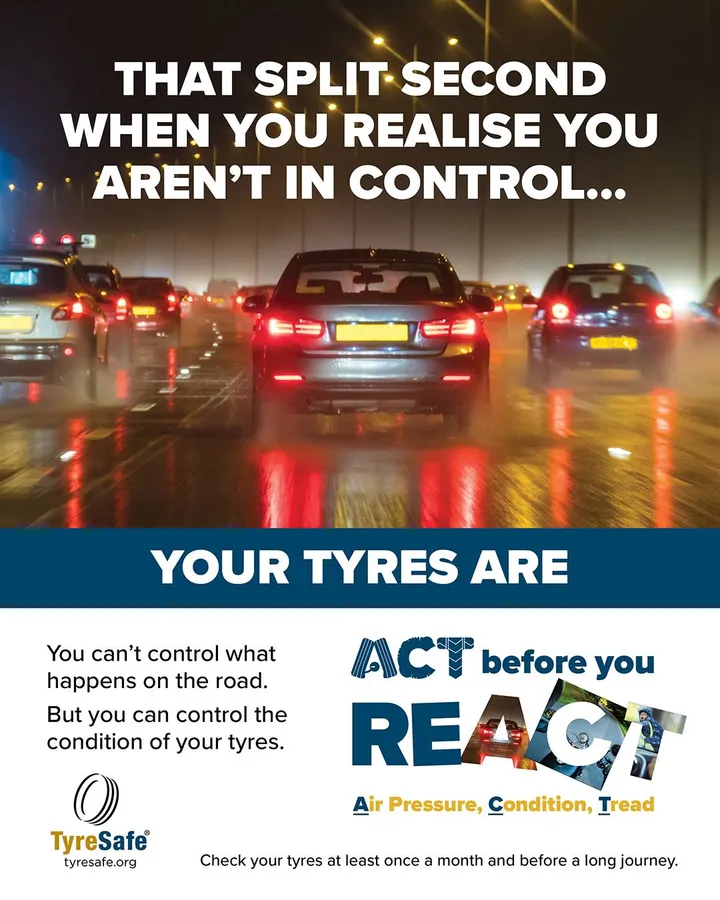
You are not in control if your tyres are not road-ready.
TyreSafe, Tyre Safety Month 2026
The near miss should be a warning
The research also looked at something many drivers will recognise: the near miss.
Some 38% of drivers said they had experienced a near miss during the previous 12 months.
Of those incidents, 46% were attributed to the behaviour of another road user, while 7% involved skidding or loss of grip.
But what happened afterwards is perhaps even more revealing.
Only 11% of drivers said they checked their tyres following a near miss. Meanwhile, 22% said they did nothing at all. Others were more likely to react emotionally, with 23% saying they shouted or gestured.
| After their most recent near miss | Share |
|---|---|
| Told a friend, relative or colleague | 33.5% |
| Pulled over to calm down | 24.7% |
| Gestured, shouted or sounded the horn | 22.6% |
| Did nothing and continued the journey | 22.4% |
| Checked dashboard warnings or alerts | 19.0% |
| Checked tyre pressure, condition or tread | 10.7% |
| Avoided that road or those conditions | 8.9% |
| Questioned the condition of their car | 7.2% |
TyreSafe / Opinium, April 2026. Drivers reporting a near miss, unweighted n=473. More than one answer was allowed, so the figures are not meant to total 100%. A near miss is self-reported, not a police-recorded collision, and the survey does not establish that a tyre defect caused any of them.
This is exactly the behaviour Tyre Safety Month is designed to challenge.
A near miss means that an incident was avoided. It does not necessarily mean that everything was fine.
It can be a useful prompt to ask: was my vehicle ready for that moment? Were my tyres correctly inflated? Were they in good condition? Did they have sufficient tread? Could I have done anything before the journey to give myself a greater safety margin?
Drivers cannot control another person’s actions, the weather or what happens around the next corner.
But they can control whether their own tyres are ready.
That is the move TyreSafe wants drivers to make: from reaction to prevention.
Act Before You REact
At the heart of this year’s campaign is a simple three-letter reminder: ACT.
The ACT in REACT stands for Air Pressure, Condition and Tread. These are three straightforward checks that can become part of every driver’s regular routine.
-
A
Air Pressure
Check pressures with an accurate gauge at least once a month and before long journeys. Correct inflation matters for braking, handling, fuel efficiency and how long the tyre lasts.
Where to find the right figure: the vehicle handbook, the placard inside the driver’s door or the fuel filler flap. Recommended pressures can change with the load you are carrying.
-
C
Condition
Look around the whole tyre for cuts, cracks, bulges, lumps and objects embedded in the tread. Pay particular attention after hitting a pothole or a kerb.
Do not wait on this one: a bulge or a lump can mean the structure inside the tyre has failed. Have it assessed by a qualified tyre professional as soon as you can.
-
T
Tread
Tread clears water, so it is what maintains grip in the wet. The legal minimum for cars is 1.6mm across the central three-quarters of the tread, around the whole tyre.
Legal is not the same as ideal: TyreSafe encourages drivers to check regularly and consider replacement before the limit, with 3mm often used as a practical point to act.
Do not simply rely on how a tyre looks. A tyre can be significantly underinflated without appearing obviously flat. Equally, a tyre can have sufficient tread and still be damaged, incorrectly inflated or otherwise unsuitable, which is why all three checks matter.
Uneven wear is worth noting too, because it can point to a wider vehicle or tyre problem rather than to the tyre alone.
What 29 million MOTs show about Britain’s tyres
TyreSafe’s research asks drivers what they do. The MOT record shows what testers actually find, and it points the same way.
UK Motoring analysed every normal MOT of a car aged three and over in Great Britain in 2025, 29,122,953 tests in all, from DVSA’s anonymised MOT data. Three findings stand out, and each one supports a letter of ACT.
Tyres are the third most common reason a car fails
About 7.9 million of those tests failed first time. 23.5% of the failures included at least one tyre defect, which is roughly 1.86 million cars. Only lighting and electrical faults and suspension came up more often.
| Defect category (DVSA) | Share of failed tests | Approx. failed tests |
|---|---|---|
| Lamps, reflectors and electrical equipment | 36.8% | 2.91m |
| Suspension | 32.4% | 2.56m |
| Tyres | 23.5% | 1.86m |
| Brakes | 21.8% | 1.73m |
| Visibility | 15.2% | 1.20m |
A failed test counts once in every category it has a defect in, so the shares add to more than 100%.
Worn tread is the most common tyre failure of all
Within those failures, the single most common tyre item is tread below the 1.6mm limit. The two that follow it are damage rather than wear, which makes the case for checking condition as well as depth.
| Tyre failure item (DVSA wording) | Share of failed tests | Approx. tests |
|---|---|---|
| Tread depth below requirements of 1.6mm | 8.2% | 645,000 |
| Ply or cords exposed | 3.1% | 248,000 |
| Cut deep enough to reach the ply or cords | 3.0% | 237,000 |
Worn tread was among the ten most common failures in 117 of the 118 postcode areas we analysed. It is not a regional problem. It is everywhere.
The most common MOT advisory in Britain is a tyre close to the limit
This is the finding that matches TyreSafe’s message most closely.
More than half of all car MOTs in 2025, 51.9%, came back with at least one advisory. Across the 4,011 model years with enough tests to report, the most common advisory of any kind was “Tread depth: worn close to legal limit or worn on edge”. It was the number one advisory for 2,939 of those model years, 73.3% of them, and it appeared somewhere in the top ten for 4,001 of the 4,011.
- 18.2%of MOTs carried a tread-close-to-the-limit advisory, around one car in five
- 2,939of 4,011 model years had it as their single most common advisory
- 4,001of 4,011 model years had it somewhere in their top ten advisories
An advisory is not a failure. It is a tester saying the car passes today and the tyre will not pass next time. On roughly one MOT in five, that warning is about tread.
Legal is not the same as road-ready
A tyre on 1.7mm is legal. It also has an MOT advisory against it, and far less water-clearing capacity than a new one. The MOT record is full of cars that passed their test with a tyre the tester had already written down, which is precisely the gap TyreSafe is asking drivers to close before the weather closes it for them.
UK Motoring analysis of DVSA anonymised MOT data for 2025 tests, Great Britain, cars aged three and over, retests excluded. The data is provisional. Category and item shares are shares of failed tests; the advisory share is a share of all tests. Advisory figures cover the 4,011 model years with enough tests to publish, 28.5 million of the 29.1 million tests, and are taken from each model year’s ten most common advisories, so an item outside a top-ten list is not counted. 18.2% is therefore a floor rather than an exact figure, although tread appeared in all but 10 of the 4,011 lists. Full method: our MOT methodology.
Why tyre checks matter
It is easy to think of a tyre check as a box-ticking exercise.
It is not.
Tyres affect acceleration, braking, steering and cornering through a relatively small contact patch with the road.
Correctly maintained tyres can help provide the grip and handling a driver needs when something unexpected happens.
The consequences of neglect can be serious. The latest figures from the Department for Transport show that 201 people were killed or seriously injured in tyre-related incidents in 2025.
TyreSafe also highlights evidence from the National Highways Fatality Database showing that, in fatal incidents where car tyres were identified as a causal factor, 75% of tyre defects were attributed to lack of maintenance. For other vehicles, the figure was 61%. The analysis covered 2014 to 2022 and was verified by the Transport Research Laboratory, with 1,954 vehicles examined by forensic investigators.
There is also a financial reason to pay attention.
TyreSafe estimates that around £1 billion worth of fuel is wasted in the UK each year as a result of underinflated tyres. Poorly maintained tyres can also wear more quickly, while tyre-related problems can result in breakdowns, disruption and unexpected costs.
A few minutes checking tyres is therefore not simply about avoiding an accident. It is part of maintaining the vehicle properly.
Why October matters
Tyre Safety Month is deliberately held in October.
As autumn progresses, drivers face increasingly changeable conditions, including wet roads, reduced daylight and potentially more challenging driving conditions.
The Met Office’s long-term UK climate averages show October has historically been one of the UK’s wetter months, with an average of 122.5mm of rainfall across the UK during the 1991 to 2020 period.
That makes October a natural point to remind drivers that tyre condition matters particularly when roads are wet.
Wet weather can make stopping distances longer and reduce available grip. When that happens, the condition of the tyres becomes even more important.
The campaign is therefore not asking road users to wait until winter arrives, or until something goes wrong.
It is asking them to prepare now.
Vans, fleets and cars nobody checks
One detail in the survey is worth drawing out. The question asks when a driver last personally checked their tyre pressure and tread depth, and it deliberately excludes checks made at an MOT or a garage. One driver in ten, 10.0%, said they had never done it themselves.
That matters most where the question of whose job it is has no obvious answer.
Vans and company cars are the clearest case. TyreSafe’s National Highways figure for vehicles other than cars is that 61% of tyre defects in fatal incidents were attributed to lack of maintenance, and a business running a fleet carries that exposure across every vehicle at once rather than one at a time. TyreSafe’s own Fleet Resource Hub sets out what a tyre policy should cover: who checks, how often, and what gets recorded. It is worth reading alongside whatever fleet insurance arrangement a business already has, because both come down to the same question of who is responsible for the vehicle.
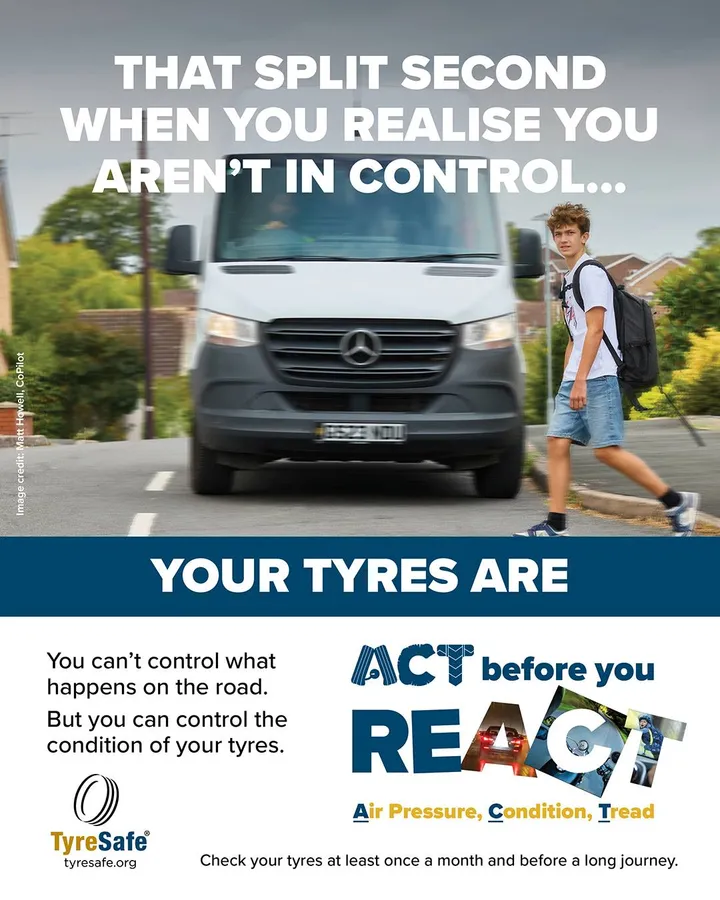
Borrowed cars are the other case. A car you are driving for an afternoon is still a car whose tyres you are relying on, and the person who checks them is usually the owner rather than the driver. If you are borrowing a vehicle, or lending yours, the ACT checks take about as long as sorting out temporary car insurance in the UK does.
Don’t wait for a near miss
There will always be things on the road that drivers cannot predict.
The weather can change. Traffic can stop suddenly. Another driver can make a mistake. A pothole can appear where you least expect it.
Being prepared does not mean believing that nothing will ever go wrong.
It means making sure you have done what you can before it does.
And when it comes to tyres, preparation is remarkably simple.
Before your next journey
- Air pressure. An accurate gauge, once a month and before anything long, set to the figure in the handbook or on the door placard.
- Condition. Run a hand round the inner and outer walls of each tyre, which is where kerbing shows, and look for cuts, cracks, bulges and anything embedded in the tread.
- Tread. A 20p coin in the main grooves: if the outer band of the coin is visible, the tread may be close to the legal limit and the tyre needs a professional opinion.
- The spare, if the car has one, and the repair kit if it does not. Check the kit is still in date.
- Your last MOT. Advisories tell you what a tester already noticed. You can look up any car’s MOT history with our free vehicle check.
It takes only a few minutes.
TyreSafe is encouraging drivers to make ACT part of their regular driving routine, not something they remember only after a scare.
Because when you suddenly need your tyres to brake, steer or maintain grip, that is not the moment to discover whether they were ready.
This October, TyreSafe’s message to every road user is simple: don’t wait for a near miss to remind you. Act Before You REact.
Get involved with Tyre Safety Month
Tyre Safety Month runs throughout October and everyone can get involved.
Drivers can support the campaign by checking their own tyres, sharing TyreSafe’s campaign messages with friends and family, and encouraging other road users to make regular tyre checks part of their routine.
Tyre businesses, road safety organisations and other supporters can also share campaign content across social media and digital channels, display campaign materials, use the ACT message in customer communications and encourage customers to check their tyres before long journeys and as the seasons change.
TyreSafe provides campaign resources including social media content, graphics, videos, ready-to-use copy and print-ready materials.
The campaign can be followed using #TyreSafetyMonth, #ActBeforeYouREact, #ACTonTyres and #TyreSafety.
For more information and tyre-check guidance, visit TyreSafe.
Sources
- Department for Transport, Reported Road Casualties Great Britain, final results 2025.
- TyreSafe, Tyre Safety Month 2026 Act Before You REact campaign research. Fieldwork by Opinium, 24 to 28 April 2026: 2,000 UK adults, of whom 1,263 regular car drivers and 473 reporting a near miss.
- TyreSafe, Tyre Checks Guide.
- National Highways Fatality Database, 2014 to 2022, verified by the Transport Research Laboratory.
- Met Office, UK 1991 to 2020 climate averages.
- DVSA anonymised MOT data, 2025 tests, Great Britain. UK Motoring analysis.
FAQs
What is the legal minimum tyre tread depth in the UK?
1.6mm for cars, across the central three-quarters of the tread and around the entire circumference. TyreSafe encourages drivers to consider replacement before that, with 3mm often used as a practical point to act.
How do I check my tyre tread with a 20p coin?
Put a 20p coin into the main tread grooves. If the outer band of the coin is visible, the tread may be close to or below the legal limit and the tyre should be checked by a professional.
How often should I check my tyre pressures?
TyreSafe advises checking with an accurate gauge at least once a month and before long journeys, against the pressures in the vehicle handbook, on the placard inside the driver’s door or on the fuel filler flap.
Do worn tyres fail an MOT?
Yes. Tread below 1.6mm is a failure item, and it was the most common individual tyre failure in Great Britain in 2025, in about 8.2% of all failed tests.
What does a tyre advisory on my MOT mean?
The car passed, but the tester has recorded something to watch. “Tread depth: worn close to legal limit or worn on edge” was the most common advisory of any kind in the model years we analysed, so it is usually a warning that the tyre will not pass next time.
What is the fine for illegal tyres?
Up to £2,500 and 3 penalty points for each illegal tyre, according to GOV.UK, so a car with four could in principle reach £10,000 and 12 points.
Can a tyre be unsafe even with legal tread?
Yes. A tyre can have sufficient tread and still be incorrectly inflated, cut, cracked, perished or bulging, which is why TyreSafe’s ACT check covers air pressure and condition as well as tread.
When is Tyre Safety Month 2026?
Throughout October 2026. The campaign is called Act Before You REact and can be followed using
About the author
The UK Motoring editorial team analyses official motoring data and checks every figure against its source before it is published.